The Power of Handwriting
In our Level 2 workshop, I ask members to first write their anwers by by hand on paper rather than typing them on a computer. This is intentional.
Putting that workshop together has meant I’ve tested this process hundreds of times on paper, and on a computer. This picture represents just a few days worth of testing by hand.
And I can tell you from experience that writing by hand produces consistently better results.
Why?
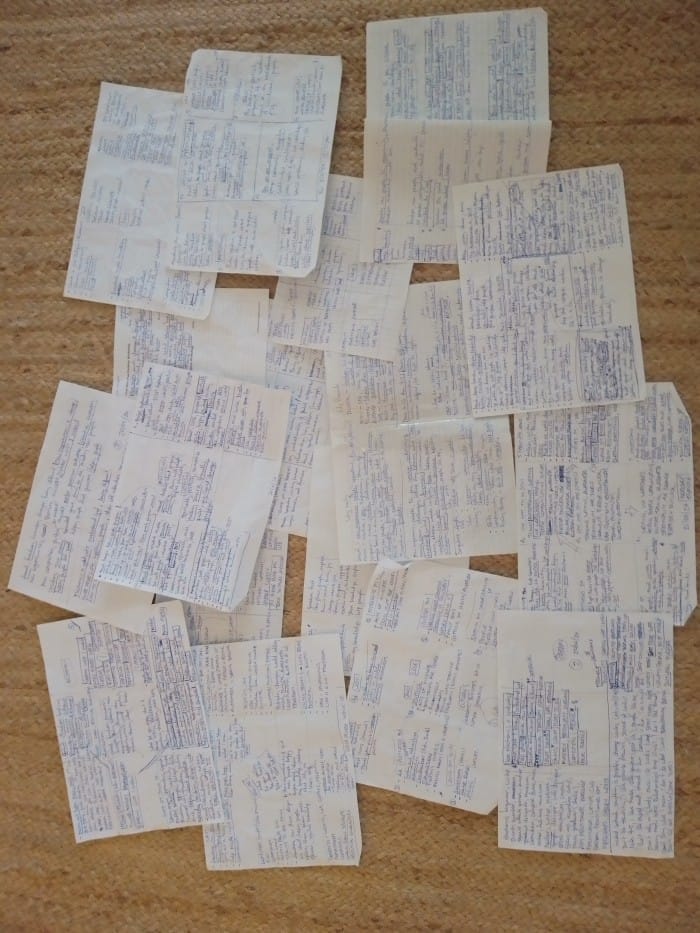
Just some of my hand-written tests
When people write by hand, the process naturally slows down. This gives the mind more space to reflect, notice patterns, and generate clearer answers. Typing, on the other hand, tends to keep the mind in a fast, reactive mode, which often leads to surface-level responses.
Handwriting also engages the brain more fully than typing. It involves coordination between movement, vision, memory, and attention. Because of this, ideas tend to flow more freely, and people often access thoughts they wouldn’t reach as easily on a keyboard.
Another important difference is focus. When you write by hand, there are fewer distractions. You’re not switching tabs, checking notifications, or editing as you go. This makes it easier to stay present with the exercise and follow the process as it’s designed.
Trust me when I say, you get much better results when you write things down with a blue pen on white paper (or the A4 template provided in the workshop that members can print out and write on).
It slows the mind
It improves focus
It encourages reflection
It allows clearer ideas to surface
It's a lost art!
GET STARTED
WITH LEVEL 1
It shows the four essential needs of the mind, and how they form the blueprint for the perfect life.
Latest Posts

The Author
Matt Corcoran is the founder of Find True Purpose. He has studied the purpose and meaning of life for more than 30 years, as a passion, a complimentary therapist and practitioner, and living his own big dreams.
Check out our Online Workshop
Follow Us
Proudly made
in Australia
by real humans.
ABOUT US
We help people find their true purpose in life and live it fearlessly as a lifestyle, pastime, business or career. Satisfaction guaranteed, or twice your negativity back!